FILE / Science
How Solar Panels Turn Sunlight into Everyday Electricity
Curious how rooftop solar panels actually turn sunshine into the electricity that runs your lights and appliances? This overview walks through photovoltaic cells, inverters, and real‑world issues like shading so you can judge if a home solar setup makes sense for you.
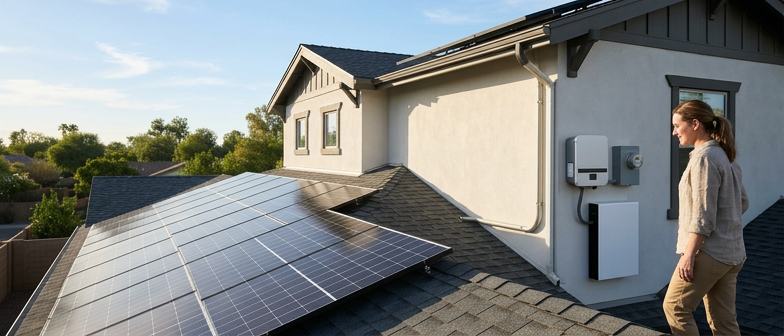
From Sunlight to Household Electricity
Solar panels turn sunlight into electricity by using many small photovoltaic cells wired together. Each cell is made from semiconductor materials, often silicon, that loosen electrons when light hits them, creating a small direct current. When large numbers of these cells are connected inside a panel and several panels are linked in an array, the connections combine voltage and current into usable electrical power; series connections add voltage and parallel connections add current. This process is known as the photovoltaic effect, which converts light energy directly into electrical energy without moving parts and operates as long as enough light reaches the cells.
Homes and most appliances use alternating current instead of direct current, so a solar inverter sits between the panels and the breaker panel. It takes the direct current from the array and converts it into alternating current with a voltage and frequency suitable for household circuits and, where wiring and local rules permit, for feeding power back to the grid. In practice, this allows sunlight on the roof to help run everyday equipment, with output shaped by time of day, weather conditions, and shading across the array.
Solar Panel Basics and Key Components
A rooftop solar system is more than the shiny panels visible from the street. Each panel is built from many photovoltaic cells, typically made of silicon, wired together and sealed under glass with a weatherproof backing. When sunlight hits these cells, it frees electrons and produces direct current, or DC, electricity. The cells are grouped into panels, panels are wired into strings, and those strings form an array sized to match a building’s typical electricity use and roof area. Energy agencies describe this same structure and note that the power leaving the array is still DC and not yet suitable for standard appliances.
To make the solar output usable, the array connects to a solar inverter, which converts DC into alternating current, or AC, the form used in ordinary outlets. The inverter manages how solar power flows into the building’s electrical panel and, where rules allow, how it exchanges power with the utility grid. Required safety devices help isolate specified parts of the system when necessary, and monitoring equipment records how much electricity the system generates. In everyday operation, sunlight hits the cells, they produce DC, the inverter turns it into AC, and the building’s circuits draw on this energy before additional power is supplied from the grid.
Inside a Photovoltaic Cell
A single photovoltaic cell is a thin sandwich of carefully layered materials that together create an electric field. Most modern cells use a wafer of crystalline silicon that has been treated so that one side has extra electrons and the other side has too few. This treatment, called doping, turns one layer into an n-type region and the other into a p-type region. Where those layers meet, electrons and holes are pushed apart, forming an internal electric field that works like a one-way slope for charges. Metal grid lines on the top and a metal backing on the bottom allow this built-in field to push electrons into an external circuit when light hits the cell, as described by the U.S. Department of Energy and the U.S. Energy Information Administration in their photovoltaic basics pages.
The Physics of Turning Sunlight into Electricity
A solar panel converts sunlight into electricity when photons knock electrons loose in a thin semiconductor layer, typically silicon. Each photovoltaic cell combines two silicon layers, one with extra electrons and one with fewer, creating an internal electric field at their junction. When light with enough energy hits this junction, freed electrons are pushed in a preferred direction by that field, producing a direct current of electricity.
This direct current flows through fine metal grid lines on the cell surface and into larger conductors that link all the cells in a panel. Several panels are wired together so their individual outputs add up to a higher overall current and voltage. In a typical home installation, this direct current travels through cables to a central inverter or to smaller inverters placed near individual panels. System layout, cable length, and connection quality are managed to limit resistance and reduce energy losses during electricity generation.
Because household circuits use alternating current, the inverter converts the panels’ direct current into an alternating waveform that matches grid voltage and frequency standards. It does this by rapidly switching and shaping the current, while also monitoring for conditions such as grid outages or wiring faults and shutting down when needed for safety. In practice, planning a system usually involves checking how much sun the roof receives, looking for shading at different times of day, estimating electricity use, and discussing suitable inverter options and system size with a qualified installer.
Role of the Solar Inverter
A solar inverter links the panels to usable electricity by turning the direct current they produce into alternating current that matches the grid and household circuits. It continually measures the array’s output, synchronizes the waveform, and disconnects when it detects faults such as sudden voltage changes or a power outage, which helps protect people and equipment. In a typical rooftop system the inverter also monitors efficiency and records electricity generation, while some designs use several smaller inverters so that shade on one panel reduces the output of only that section instead of the entire array.
Real-World Factors: Shading, Angle, and Location
Outside the lab, solar panels work only as well as the sunlight that actually reaches them. Shade from trees, chimneys, or nearby buildings can cut electricity because panels in a series string share the same current, so one darkened panel can pull the whole group down. Modern designs, including electronics that track each module and careful layout, can limit these losses but not remove them completely. For this reason, site planning often includes checking how the sun moves through different seasons and choosing clean, unobstructed roof or ground areas so that production stays close to typical values shown in regional solar resource tools.
Panel tilt, direction, and local climate further shape real-world electricity generation. Fixed rooftop systems in the northern hemisphere are often pointed generally south, with a tilt similar to local latitude, then adjusted to match actual roof angles or to favor morning or afternoon use. Weather patterns also matter, because cloudy, dusty, snowy, or very hot conditions change how efficiently photovoltaic cells convert sunlight. Homeowners who note regular shading, review local sun data, and discuss orientation options with an installer can better match expectations to the likely yearly output of their solar array.
Panels, Batteries, and Power Outages
Panels generate electricity; they do not by themselves store it for use at night. Storage requires a battery or another storage system. A typical grid-connected solar installation shuts down grid export during an outage to protect utility workers. Supplying a home during an outage requires a system specifically designed for backup operation, with suitable controls and isolation; simply having panels or a battery does not establish that capability.
Solar equipment can remain electrically hazardous in daylight even when a switch is off. Leave installation, maintenance, and fault diagnosis to qualified professionals, and follow the system’s safety instructions.
Q&A
-
How does a solar panel turn sunlight into electricity?
A panel contains many photovoltaic cells made of semiconductors such as silicon. Sunlight knocks electrons loose, and an internal electric field pushes them in one direction, producing direct current (DC) power. -
What inside a photovoltaic cell enables this conversion?
Each cell has two treated silicon layers, one with extra electrons and one with fewer. Their junction creates an electric field, and metal contacts collect the moving electrons into an external circuit. -
What role does the solar inverter play?
It converts DC power from the panels into alternating current (AC) that household wiring and the grid use, and it monitors the system so it can shut down during faults or grid outages. -
How does partial shading affect output?
In series strings, current is limited by the lowest‑producing panel. A shaded panel can reduce power from the whole string, though module‑level electronics and careful layout can reduce these losses. -
Where can I learn more technical details?
Public energy agencies provide introductions to photovoltaic basics and solar electricity, including the solar pages of the U.S. Department of Energy and the Energy Information Administration.
References
- https://www.energy.gov/cmei/systems/solar-photovoltaic-cell-basics
- https://www.eia.gov/energyexplained/solar/photovoltaics-and-electricity.php?form=MG0AV3
- https://www.ucs.org/resources/how-solar-panels-work
- https://education.nationalgeographic.org/resource/solar-cells-how-solar-panels-work/
- https://solareis.anl.gov/guide/solar/pv/index.cfm