FILE / Science
Why Ice Floats on Water and What It Means for Lakes in Winter
Wondering why ice floats instead of sinking and what that means for lakes in winter? Learn how water’s unusual density and hydrogen bonds let ice form an insulating lid that protects cold-season lake ecosystems and keeps life going under the ice.
The short answer: ice is less dense
An ice cube floats because ordinary ice is less dense than liquid water. Freezing changes the arrangement of water molecules into a more open crystal structure. The same mass then occupies more space. It has not lost mass; its mass per unit volume—its density—has decreased.
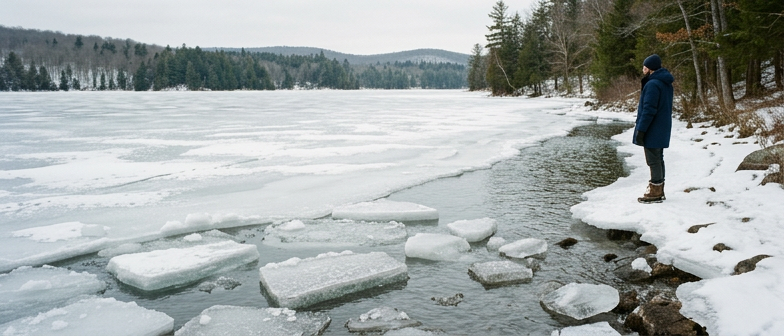
Floating ice matters well beyond a drink. In a winter lake, it can form a surface cover while water remains liquid beneath. That cover slows heat loss and changes the light and oxygen conditions experienced by aquatic life.
What changes at the molecular level?
A water molecule contains two hydrogen atoms and one oxygen atom. Attractions called hydrogen bonds form between neighboring molecules. These are different from the covalent bonds holding the atoms together within each molecule: freezing water does not turn it into a new chemical substance.
In liquid water, molecules move around and the hydrogen-bond network can rearrange and flex. In ordinary ice at atmospheric pressure, the molecules occupy a more ordered, open framework. The liquid can pack more closely on average than this solid structure.
This is an unusual feature of water. Many substances become denser when they solidify, but it is not a rule that every solid must be denser than its liquid. The arrangement of the particles matters as well as whether they are moving freely.
How density leads to floating
A submerged object displaces water. The displaced water produces an upward buoyant force. An ice cube rises until it displaces enough water to balance its weight, then floats with part of the cube above the surface.
You can compare equal masses of liquid water and ice: the ice takes up more volume. Or compare equal volumes: the ice contains less mass. Keeping those two comparisons separate avoids the misleading claim that freezing somehow makes the same water “lose weight.” Air bubbles can affect a particular cube, but trapped air is not the basic reason ordinary ice floats.
Why 4°C matters in a freshwater lake
Pure liquid water near atmospheric pressure reaches its greatest density at about 4°C, or 39°F. Cooling water from a warmer temperature toward that point generally makes it denser. Cooling it further toward freezing makes it less dense again. This change begins while the water is still liquid; it is not only a sudden effect after ice appears.
In a seasonally freezing freshwater lake, cooling at the surface can help denser water sink and mix with deeper water. Wind also contributes. Once surface water becomes colder than about 4°C, it can remain above denser water below. With enough further cooling, the surface freezes.
This is a simplified picture, not a temperature map for every lake. Lake depth, wind, inflows, dissolved substances, and weather affect mixing and temperatures. Salt water behaves differently, so the freshwater explanation should not be applied unchanged to the ocean.
What the ice cover does—and does not do
The floating cover reduces direct contact between liquid water and cold air. Ice, and especially snow on top, can slow further heat loss. In many lakes, water just below the ice is near freezing, while deeper water can be closer to 4°C. The layer immediately under the ice is not automatically the warmest or densest water.
The cover helps maintain liquid habitat, but it does not guarantee survival for every organism. Fish, plants, and microbes still need suitable conditions. Ice restricts gas exchange with the air, and snow can reduce the light available for photosynthesis. Organisms continue consuming oxygen, so oxygen shortage can become a problem in some lakes and ponds.
Nor does floating ice mean a lake can never freeze solid. Shallow water bodies can freeze to the bottom in sufficiently cold conditions. How much liquid remains depends on depth, heat stored in the water and sediments, and the duration and severity of winter.
A simple observation at home
Place a few ordinary ice cubes in a clear cup of water and watch their position. Most of each cube stays below the surface while a smaller part remains above it. Gently push one under with a spoon and release it to observe the upward motion.
This shows buoyancy; it does not measure the precise density or reproduce a lake's winter ecology. You do not need to visit frozen water to see the principle. Floating lake ice can be thin or uneven, and its appearance does not establish that it is safe to walk on.
The useful connection is from structure to density to habitat: water's molecular arrangement makes ordinary ice buoyant, and that buoyancy allows a winter lake to develop a surface cover over liquid water.