FILE / Science
Composting Basics: What Really Happens Inside a Backyard Pile
Wondering what’s really happening to those food scraps in your backyard bin? This guide walks through the science inside a compost pile—how microbes decompose waste, why carbon–nitrogen balance, moisture, and oxygen matter, and what simple steps keep your pile hot, odor‑free, and productive.
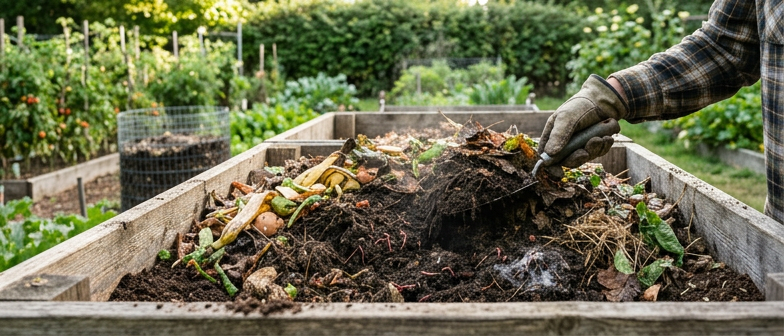
What Actually Happens Inside a Compost Pile?
Inside a compost pile, billions of microorganisms break down food scraps, yard trimmings, and other organic materials into a dark, crumbly product called finished compost. Bacteria and fungi start by feeding on easily digested materials such as fruit and vegetable peels, coffee grounds, and fresh grass, and their activity generates heat, so the center of an active pile often feels warm. Larger organisms like worms and insects move in later to chew, shred, and mix the material, speeding decomposition and creating a more even texture. When conditions are right, the pile has a mild earthy smell rather than a strong rotten odor.
This small ecosystem depends on a few basic conditions: enough moisture for microbes to move and feed, enough oxygen for them to respire, and a workable mix of nitrogen rich “green” ingredients and carbon rich “brown” materials. If the pile is too wet and compacted, oxygen runs low and anaerobic microbes produce rotten egg smells; if it is too dry, the process slows or stops. Many home guides recommend adding a mix of kitchen scraps and dry leaves and occasionally loosening or turning the pile to keep air and water moving so organic waste can gradually become a stable, nutrient rich amendment for garden soil.
The Decomposition Cast: Microbes, Heat, and Time
Inside a compost pile, the main actors are microscopic organisms that break down food scraps and yard waste into simpler materials. Bacteria start work as soon as fresh material is added, feeding on sugars and other easy compounds. As they respire, they release carbon dioxide and heat, so a well-built heap with enough moisture and air often feels warm during the first days or weeks of active decomposition.
As temperatures rise, different communities take over according to heat and oxygen levels. During a hot phase, heat-loving microbes become more active. Effective destruction of pathogens and weed seeds depends on controlled temperature, exposure time, and heating throughout the material; a warm home pile does not prove sanitization. As the easy food is consumed, temperatures fall, and fungi, actinomycetes, and small invertebrates such as earthworms move in to work on tougher materials like small twigs, paper, and dried leaves. This cooler curing phase helps stabilize the compost so it is less likely to reheat or produce strong odors when used.
These stages can be followed by simple observation. In a balanced pile with adequate air and moisture, the center usually feels warm at first, the volume gradually shrinks, and recognizable items such as fruit peels and coffee grounds fade. Cooling alone does not prove maturity: a dry, small, or poorly balanced pile may also stay cool. Allow a curing period and assess earthy smell, dark crumbly texture, and lack of recognizable food scraps together. If uncertain, consult local extension guidance before using it around sensitive plants.
| Compost stage | Typical temperature feel | Main microbes and helpers | What you notice | Home composter action |
|---|---|---|---|---|
| Early active heating | Warm to hot core | Bacteria dominating | Fresh scraps still visible | Check moisture and add air |
| Thermophilic peak | Very warm center | Heat-loving bacteria | Steam on cool mornings | Turn pile if overly hot or compact |
| Cooling transition | Mild warmth | Bacteria and fungi | Texture starting to crumble | Mix in any wet or dry patches |
| Curing and maturation | Mostly cool | Fungi, actinomycetes, invertebrates | Earthy smell, few odors | Turn occasionally or leave undisturbed |
| Finished compost | Same as ambient | Stable microbial community | Dark, crumbly, ingredients indistinct | Store dry or apply to soil |
From Fresh Mix to Finished Compost
Right after you build a pile, it looks like a loose mix of food scraps, leaves, and yard trimmings. Fresh material can smell like a trash can until it is covered with dry browns. Within a few days, bacteria and fungi begin breaking down sugars and proteins, the pile heats up, and on cool mornings you may see steam, a visible sign of active decomposition described in many home composting guides.
Balancing Ingredients: Carbon, Nitrogen, and Moisture
Inside a compost pile, the balance between carbon and nitrogen keeps microbial activity going. Dry leaves, shredded cardboard, and small twigs are carbon rich materials that provide energy and structure. Food scraps, coffee grounds, and grass clippings supply nitrogen, which supports microbial growth. If there is too much carbon, decomposition slows because microbes cannot build new cells. If there is too much nitrogen, the pile can become compacted, wet, and smelly as oxygen is squeezed out and excess nitrogen is released as ammonia.
Many introductory guides describe a moderate carbon to nitrogen ratio as ideal because it supports steady, relatively odor free breakdown under typical backyard conditions. In everyday practice, ingredients can be grouped as browns and greens instead of calculating exact ratios. Browns are dry and bulky and tend to be rich in carbon, while greens are moist materials with more nitrogen. A common rule of thumb is to add about two or three containers of browns for every container of greens, measured by volume rather than as an exact chemical carbon-to-nitrogen ratio, giving microbes both fuel and nutrients to heat the pile and turn kitchen and yard waste into stable compost.
Moisture links these ingredients because water lets microbes move, feed, and multiply while also influencing how much oxygen can enter the pile. Compost that feels like a wrung out sponge, damp but not dripping, usually allows microbes to reach both carbon rich materials and nitrogen rich food scraps while still getting air. When the pile is too wet, water fills air spaces and oxygen becomes limited, leading to slower, smellier breakdown. When it is too dry, even a well balanced mix can stall as microbes become inactive. Checking the feel of the material and adjusting with either dry leaves or a little water while turning the pile helps maintain suitable conditions.
Carbon–Nitrogen Balance in Everyday Materials
Household compost materials are often described as carbon rich or nitrogen rich. Dry leaves, shredded paper, sawdust, and small wood chips mainly supply carbon, giving the pile structure and soaking up extra moisture. Fresh items such as food scraps, coffee grounds, and grass clippings provide nitrogen that supports the microbes driving decomposition. A practical approach is to mix several kinds of dry browns with several moist greens instead of trying to measure exact ratios.
If the mix contains too many kitchen scraps or fresh grass, the compost can become wet, compacted, and smelly because oxygen is limited. Adding dry leaves or shredded cardboard and lightly turning the pile can restore airflow and absorb moisture. When the pile is dominated by dry materials and breaks down slowly, more food scraps, other green materials, and some water can increase nitrogen and revive microbial activity. Observing smell, texture, and how fast materials shrink helps guide these adjustments.
Air, Water, and Structure Inside the Pile
Inside a compost pile, air, water, and physical structure determine whether fast, clean decomposition or slow, smelly decay dominates. Aerobic microbes need oxygen to transform food scraps and yard waste into stable compost, releasing heat and carbon dioxide. When the pile is dense or compacted, air spaces collapse and oxygen drops, favoring anaerobic microbes that generate methane and strong odors instead of crumbly, earthy material. A mix of fine and coarse pieces, such as shredded leaves with kitchen scraps, creates channels for air, and turning or poking the pile helps restore oxygen when activity slows or smells increase.
Moisture is just as important as air because decomposers live in a thin film of water coating each particle. Compost usually works best when it feels like a wrung-out sponge: moist so materials are soft and flexible, but not dripping. If the pile dries out, microbial activity stalls; if it becomes waterlogged, oxygen is forced out and low-oxygen conditions return even when the structure looks loose. At home, it is practical to add dry, absorbent materials like leaves or shredded cardboard when the pile is soggy, and to sprinkle or hose it lightly when it is dusty, so structure, air flow, and moisture stay in balance.
What to Leave Out of a Basic Backyard Pile
For ordinary backyard composting, follow local guidance and leave out meat, fish, bones, dairy, greasy food, pet waste, and treated or painted wood. Avoid diseased plant material or invasive weeds unless the composting process is specifically managed for those risks. “Compostable” packaging may require an industrial facility and may not break down in a home pile.
Cover food scraps with browns, keep the pile managed to discourage pests, and wash your hands after handling compost. If you have a health condition that affects safe handling of soil or decaying material, ask a clinician about appropriate precautions.
Q&A
-
What happens inside a compost pile?
Microorganisms digest food scraps and yard waste, using carbon for energy and nitrogen for growth. Their activity releases heat, water vapor, and carbon dioxide, gradually forming dark, crumbly compost. -
Why does a compost pile get hot?
Microbial metabolism releases heat, which a sufficiently active and well-insulated pile can retain. Some home piles remain cool and still decompose. Do not assume the whole pile has reached a sanitizing temperature or use warmth alone as proof of safety. -
Why does the carbon–nitrogen mix matter?
The balance controls speed and odor. A practical guide is roughly two to three parts dry browns, such as leaves or shredded cardboard, to one part moist greens like food scraps or fresh grass. -
How damp should compost be?
Aim for moisture like a wrung‑out sponge: moist but not dripping. If it is wet or smelly, mix in dry leaves or paper. If it is dusty and cool, add water while turning the pile. -
How can I limit smells from food scraps?
Chop large pieces, mix them with dry material, and cover fresh scraps with a thin layer of leaves or finished compost. Turning the pile improves oxygen supply and reduces rotten odors.
References
- https://www.epa.gov/sustainable-management-food/approaches-composting
- https://www.ncagr.gov/divisions/agronomic-services/waste-analysis/understand-your-compost-report
- https://extension.colostate.edu/resource/making-compost/
- https://content.ces.ncsu.edu/large-scale-organic-materials-composting
- https://www.ontario.ca/page/guideline-production-compost-ontario