FILE / Science
How to Read the Night Sky from a Bright City
Wondering if city lights have ruined the night sky for you? This guide shows how to read an urban sky using Moon phases, visible planets, night-sky maps, and even simple binocular astronomy, so you can still build a clear mental map despite light pollution.
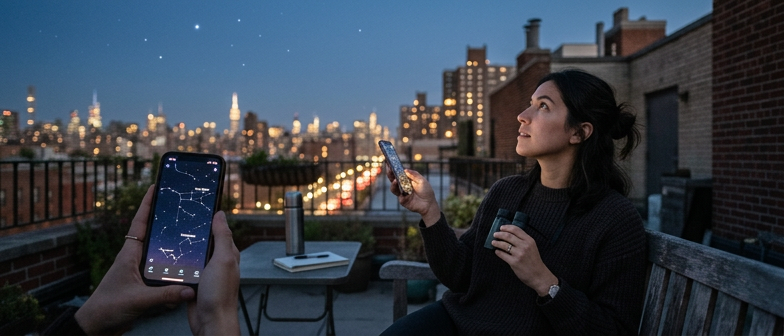
Can You Really Read the Night Sky from a City?
It is possible to read the night sky from a city, but the view is far simpler than in dark rural locations. Artificial lighting in dense urban areas removes most faint stars and the Milky Way, a form of light pollution described in many public dark-sky guidelines. Instead of crowded star fields, you usually see a smaller pattern of bright stars, a few major constellations, the Moon, and the most prominent planets when they are high in the sky. These brighter objects still follow regular paths through the seasons, so they can form the basis of a mental map of the urban sky.
Because expectations shape the experience, city stargazing works best when it is treated as pattern recognition rather than a search for every possible detail. The number of visible stars depends on local light, haze, and sightlines. Bright planets such as Jupiter, Saturn, or Mars may still be identified when their position and the observing time permit with the help of a simple sky chart or a basic night sky map. The Moon alone offers a regular lesson in changing illumination and motion, so tracking its phases and path can introduce the structure of the sky even when most stars are hidden. In this way, the bright city sky can serve as a stripped-down introduction before any trip to darker places.
Understanding City Light and the Night Sky
When you look up from a city, much of the glow across the sky comes from artificial lighting rather than the stars. Street lamps, illuminated signs, and security lights send light upward and sideways, where it scatters in the atmosphere and brightens the background. This added glow is known as light pollution, and it hides faint objects in the same way a bright flashlight can make fireflies harder to see. In many urban neighborhoods, dimmer stars fall below the limit of human vision, so the view is often reduced to the Moon, a few bright stars, and the most prominent planets. Researchers describe these conditions using sky brightness scales and maps that indicate how many stars remain visible under different levels of artificial light.
To understand what you can realistically see from your own street, it helps to pair information about sky brightness with simple planning tools. Astronomy groups and park programs publish night sky quality maps that show where the darkest and brightest regions are and how those conditions affect the visibility of the Milky Way and other features. Official guidance on outdoor lighting also explains how shielding fixtures and limiting unnecessary illumination can reduce glare over time. For someone observing from a city, choosing a spot away from direct glare, consulting a night sky map or local light pollution chart, and noticing how many stars appear in familiar constellations can give a practical sense of local sky quality and help set expectations for urban stargazing.
Finding Better Spots within the City
In a bright city, even small gains in darkness help, so look for parks, school fields, and waterfront paths where streetlights are spaced out and trees or buildings block nearby glare. Visit in daylight to note security lights, traffic, and open sightlines, then return on a clear night to see how much horizon is visible and whether car headlights or shop signs still wash out faint stars.
Rooftops, balconies, and parking decks can also improve views if they are legally open, structurally sound, and allowed by building rules. Follow posted signs, avoid locked or restricted areas, bring only light equipment, and put personal safety first by going with someone, using public spaces, and checking local rules on lighting and park hours.
Using Maps and Apps to Navigate the Night Sky
In a brightly lit city, a basic sky map or a stargazing app set to your location and time helps you identify what you are seeing. A printed monthly chart from a reliable source shows the main constellations and brightest stars that usually stand out through light pollution. Match the patterns on the chart to the sky, starting with familiar shapes or a single bright star near the horizon. Many phone apps use your device’s compass and clock to display a live, labeled view of the sky. They work best if you dim your screen, give your eyes a few minutes to adjust, and glance at the display only to confirm what you think you have already found.
To follow the changing sky and pick out bright planets, combine maps or apps with current observing guides from scientific or educational institutions. These resources indicate when planets are above the horizon and how the Moon’s phase affects what is visible from urban areas. Many apps let you hide faint stars so the display resembles the limited view from a city sidewalk, making it easier to focus on objects like Jupiter or Venus when they are up. A practical habit is to check a trusted online guide during the day, note a few targets and directions, save or print a simple chart, and then step outside to match those targets with the real sky. Over time, this routine builds a mental map you can use even without a device.
Planning with Official Night Sky Maps
Monthly sky maps from agencies such as NASA or the National Park Service show which constellations and bright objects are expected at a given month, date, and time. Choose the version for your hemisphere, then match its compass directions to city landmarks so the map aligns with the real horizon, even if only a few bright stars are visible through light pollution. Treat faint stars on the chart as optional details and rely mainly on the brightest stars and planets as reference points.
Timing Your Observing with Moon Phases and Planets
In bright urban skies, planning around the Moon and the brighter planets helps you see more. Near the full Moon, its glare adds to city lights and hides faint objects, so these nights suit viewing the Moon itself or the most obvious planets. Skies are darker near the new Moon, when the sunlit side faces away from Earth. Public Moon phase calendars from major observatories indicate these dates and show how the changing shape of the Moon alters overall sky brightness. If your goal is to trace star patterns, notice clusters, or glimpse the Milky Way from a darker park or suburb, choosing an evening close to the new Moon gives the best chance for a deeper view despite remaining light pollution.
Bright planets can still stand out above city glow, so an observing plan can focus on them even when the Moon is up. Many astronomy resources list which planets are visible to unaided eyes each month, with guidance on time and direction. You might check a current sky map in the afternoon, note when a planet such as Jupiter or Saturn will be above the horizon, and aim for a time when the Moon is low or has not risen. This way you concentrate on a small number of clear, bright targets, using a simple routine of checking the Moon phase, noting planet visibility, and choosing a one or two hour window before heading outside.
Trying Binoculars Before a Telescope
Handheld binoculars can make the Moon’s larger features and some bright star groups easier to explore. Start with a bright target identified on a chart for your location and time; steady your elbows or use a suitable mount if the image shakes. City glow still limits faint objects, and binoculars do not reproduce the detailed planetary images seen in processed photographs. A local astronomy club can help you try equipment before buying.
Never point binoculars or a telescope at or near the Sun without purpose-built, correctly fitted solar equipment and expert guidance. Ordinary sunglasses do not provide protection, and a momentary accidental view through optics can cause severe eye injury. For a beginner night session, choose targets after sunset and keep the equipment away from solar viewing.
Q&A
-
Can I still learn the sky from a bright city?
Yes. You will see fewer stars than in rural areas, but the Moon, some bright constellations, and the main visible planets remain. Because they follow regular paths, you can build a simple mental map over time. -
How does city light pollution affect what I see?
Artificial lighting brightens the background sky and hides faint stars and most of the Milky Way. In strong glare you mainly keep the Moon, a limited set of bright stars, and the most obvious planets. -
Where in a city can I observe more easily?
Choose open places with fewer direct lights, such as large parks or waterfronts. Visit in daylight to note lamps and tall buildings, then return on a clear night to see how much of the horizon and overhead sky is unobstructed. -
How can a night sky map or app help?
Printed charts and phone apps show bright patterns and names. Dim your screen, allow time for your eyes to adjust away from direct lights, and use the map mainly to check shapes you already think you see, rather than staring at the screen. -
How should I use Moon phases and bright planets?
Public Moon phase calendars show darker nights near new Moon, when faint stars are easiest. On other nights, plan sessions when the Moon or a bright planet stands high above buildings so it is easy to spot even in haze.